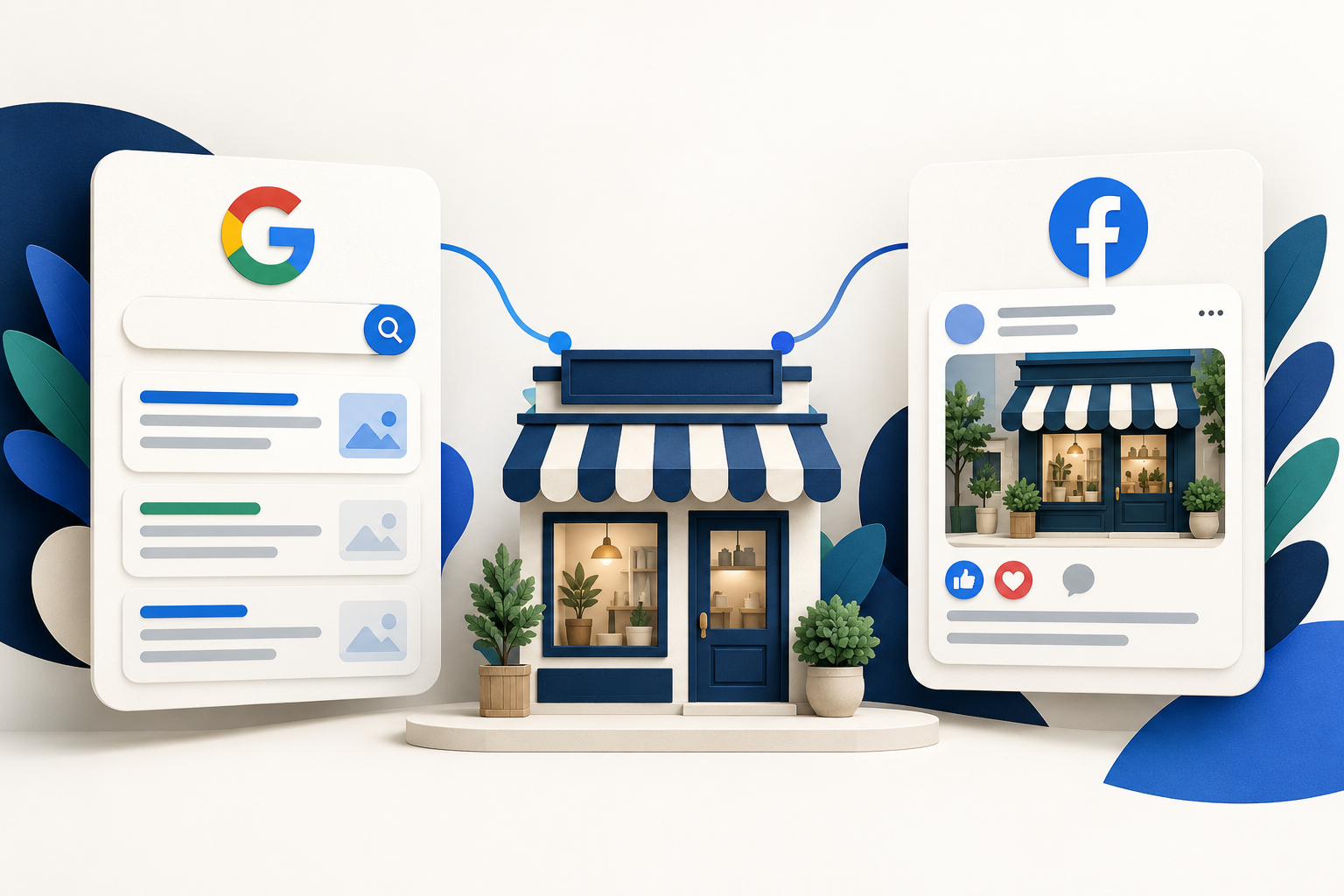
If you're wondering whether you should use Facebook ads or Google Ads for your local business, the short answer is: it depends on what your customers do right before they contact you. If people are actively searching for what you offer right now, Google Ads is your starting point. If you need to reach people before they search, to build awareness, promote an offer, or stay top of mind, Facebook and Instagram ads are the better fit.
Some businesses benefit from both, while others are better served by concentrating their budget on one well-run channel.
A common scenario plays out like this: a small business owner hears conflicting advice, tries one platform, gets mixed results, and concludes that paid advertising doesn't work. One possible problem is a mismatch between the platform and the goal; the offer, targeting, website and follow-up also affect results. Running Facebook ads to capture someone who's already searching for an emergency plumber is like putting a billboard inside a grocery store, wrong context, wrong moment.
At Prescott Digital Solutions, we start by asking what your customer does before contacting a business like yours. That answer helps shape the strategy.
This article breaks down how each platform works, how to compare costs, which business types get the most out of each, and when running both together makes more sense than choosing one.
Key takeaways
Google captures active demand: Search Ads and Local Services Ads reach people already looking for what you offer, making them the strongest channel for urgent, high-intent services.
Meta creates demand: Facebook and Instagram ads reach people based on who they are, not what they're searching for, ideal for awareness, offers, and visual businesses.
Costs depend on the campaign: Compare the same business outcome rather than unrelated click or lead benchmarks.
Cheaper leads aren't always better: Track cost per booked appointment and closed customer, not raw cost per lead.
The channels can complement each other: Test whether adding a second platform brings incremental customers rather than assuming more channels are always better.
Business type helps guide the starting point: Urgent services may be a good fit for Search; visual offers may be a good fit for Meta. Validate that starting hypothesis in your market.
What's the core difference between Google Ads and Facebook ads?
The foundational concept here is demand capture versus demand creation, or, in broader terms, paid search versus paid social. These are not interchangeable tools; they serve fundamentally different roles in the buying journey, and confusing them is the most common and costly mistake local businesses make with paid advertising.
Google captures people who are already searching
Google Search Ads can appear when someone searches for a service such as emergency plumbing or a local dentist. The user has already identified a problem and is actively looking for a solution. The ad interrupts nothing; it answers a question already being asked. This is intent-based advertising at its most direct.
Eligible businesses can also consider Local Services Ads, which have separate availability and verification requirements. This article mainly compares Google Search with Facebook and Instagram advertising; Google Ads also includes visual and video campaign types.
Facebook reaches people before they know they need you
Meta ads can reach people as they browse rather than in response to a specific search query. Delivery depends on the objective, available audience settings, creative and platform optimization. Targeting options and restrictions vary by campaign and business category.
The ad shows up in someone's feed while they're scrolling, not searching. This is awareness-based advertising, and it works best when your goal is building recognition, promoting an offer, or staying visible in the community. The audience may have zero intent right now, but a well-placed ad plants a seed that pays off when the need eventually arises.
When does Google Ads work better for local businesses?
Google Search can be a strong starting point when urgency, specificity and active search intent are involved. If someone has an immediate, specific need and types it into a search bar, they want a solution now, and your ad can be that solution. The business types below show where local PPC strategies built around Google Search tend to deliver the clearest returns.
Business types that may fit Google Search
The clearest use cases are home services and medical practices. A homeowner whose AC breaks at 9 PM searches "emergency HVAC repair," not Facebook. A patient looking for an available dentist may also begin with a search. A landlord dealing with a burst pipe isn't scrolling Instagram; they're on Google.
For these businesses, capturing high-intent search traffic delivers leads that arrive already convinced they need help. Local competition, search demand and the services you advertise can substantially change costs. Use your own campaign estimates and results rather than treating a national average as a forecast.
What Google Ads results actually look like
Track qualified inquiries, booked appointments and completed jobs—not just clicks. Calculate cost per acquired customer and compare it with the margin the work can support. A lead is only valuable if it becomes an appropriate opportunity for your business.
Call duration can help screen traffic, but a long call alone does not prove lead quality. Review outcomes and define a qualified lead before scaling.
When does Facebook (Meta) outperform Google for local businesses?
Facebook and Instagram can be useful when the goal is discovery, visual appeal, community presence or promoting an offer. If your business has something to show, Meta Ads for local businesses are built for exactly that.
Business types that may fit Meta
Restaurants are the clearest example. A customer might discover a dish in their feed and save the restaurant for the weekend. Another customer might search for somewhere to eat nearby.
Both paths can matter. The same logic applies to retail boutiques, salons, fitness studios, event venues, and home remodelers. Before-and-after remodel photos, a time-lapse of a kitchen renovation, a video tour of a new retail space, this content lands completely differently on Facebook and Instagram than a text-based search ad ever could.
Meta's Reels, Stories, and carousel formats are genuinely built for visual storytelling, and local businesses that lean into that format have a real edge over competitors who treat Meta like a second-rate Google. Choose the campaign objective and available local audience settings around the action you want customers to take. Do not assume every local business has the same targeting options.
Cost expectations and what to plan for
A cheaper click does not automatically produce a cheaper customer. Creative, competition, audience, objective, seasonality and landing-page performance all affect cost. Comparing a Meta traffic campaign with a Google lead campaign does not tell you which will generate better business results.
Plan for advertising spend, management, creative and tracking as separate items unless your proposal explicitly bundles them. Keep enough budget and operational capacity to evaluate a focused test.
How do the costs actually compare?
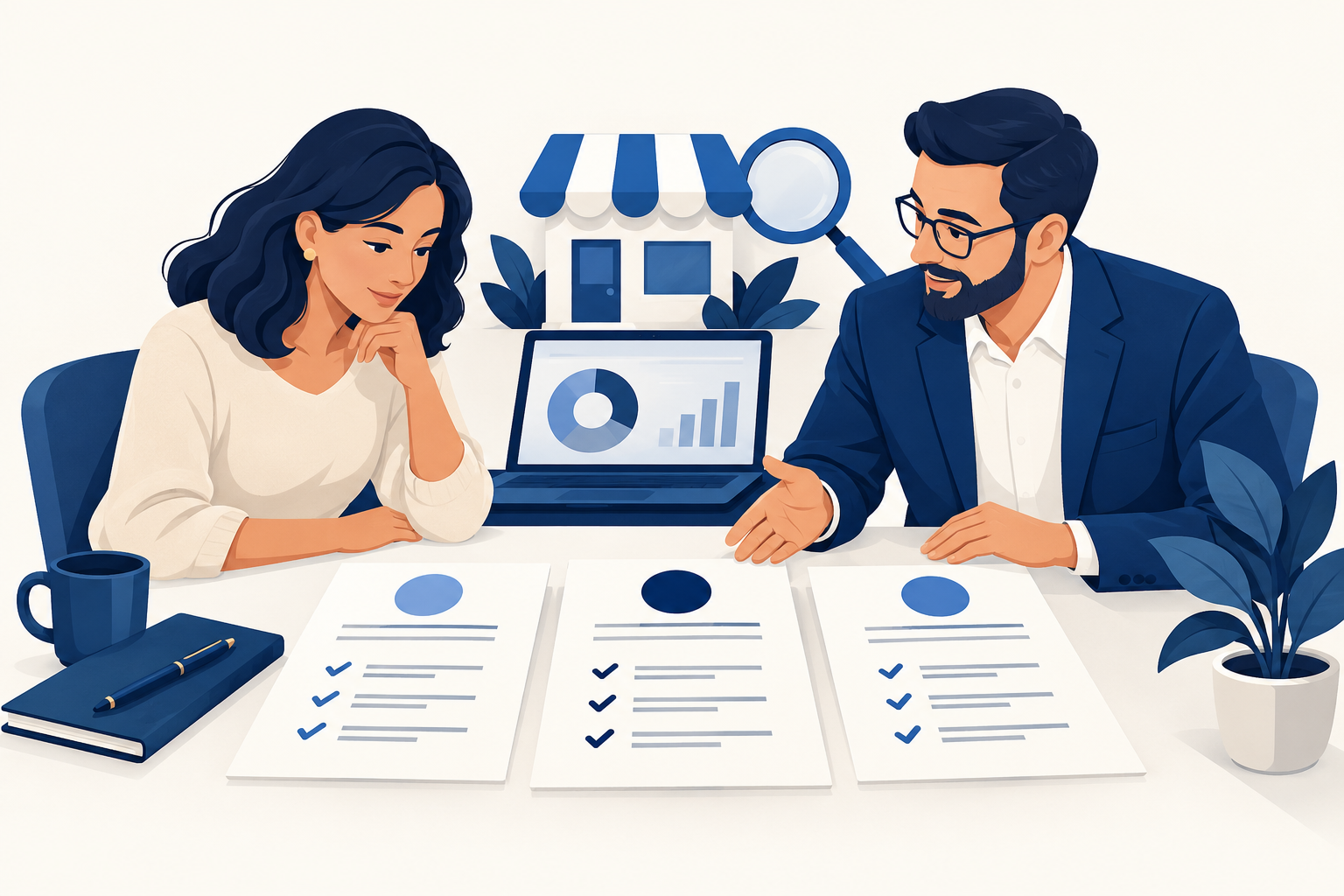
Use the same definitions on both platforms: cost per qualified lead, cost per booked appointment and cost per acquired customer. Include comparable expenses and evaluate the same time period.
Google Search is often useful for capturing an expressed need. Meta can help introduce a business or offer through visual creative. Either can generate leads or sales, and neither is universally cheaper or more profitable.
The better question is not which platform has the lowest click price. It is what a new customer contributes to your business and whether each channel acquires suitable customers at a sustainable cost.
Should I use Facebook ads or Google Ads, or run both together?
Consider both when each has a clear role and you have enough budget, creative and tracking capacity to evaluate them. Start with one if splitting your resources would leave both campaigns underfunded. Adding a platform should solve a specific business need.
How the two platforms can support each other
When someone sees a Facebook ad for a plumbing company on Monday and then searches "plumber near me" on Wednesday, recognition may influence which business they consider. Meta creates the awareness; Google captures the intent. The platforms reinforce each other in the other direction too: eligible website visitors may be reachable through a separate remarketing campaign where permitted, with appropriate tracking, consent and platform compliance.
A Google click does not automatically create a usable Meta audience. The combination is worth testing, not assuming. Both platforms may claim credit for the same sale, so do not simply add their reported conversions together.
Compare deduplicated customer outcomes and use controlled tests where practical to assess whether the second channel adds value.
The integrated strategy Prescott Digital Solutions builds for local clients
Running both channels well requires more than just having active accounts on two platforms. When separate vendors run the channels, agree on who coordinates measurement and strategy. Without coordination, inconsistent reporting and duplicated effort can make decisions harder.
At Prescott Digital Solutions, Rick builds a single cohesive paid advertising strategy covering both Google and Meta, with unified reporting, call tracking, and optimization under one point of contact. No back-and-forth between separate agencies. No conflicting data pulling in different directions.
Reporting includes the limits of attribution rather than promising certainty about every sale.
For businesses in the Prescott area, that local market knowledge informs both platform strategies at once. Which neighborhoods to target, which seasonal services to promote, which creative angles resonate with locals versus visitors, that context doesn't come from a dashboard. It comes from knowing the market.
A campaign promoting HVAC tune-ups in Prescott Valley in late September needs different timing, creative, and targeting than the same campaign run by a national firm using generic templates. Local context should inform the test; actual results determine what stays in the plan.
Match the platform to the goal
So, should you use Facebook ads or Google Ads for your local business? Neither platform is universally better. Google Search is a useful starting point when people are actively searching for what you offer and you need to intercept that intent at the right moment.
Facebook and Instagram are worth considering when you need to create demand, build local awareness, or promote something visual and community-driven that people wouldn't necessarily search for on their own. Choose the channel mix around specific business goals and measured outcomes rather than a one-size-fits-all template.
If you're a local business owner in Prescott, Prescott Valley, Chino Valley, or the surrounding area and you're trying to figure out which platform makes sense for your business right now, the answer starts with an honest look at your goals, your customer, your budget, and your competitive landscape. That's exactly the kind of conversation Prescott Digital Solutions is built for. Get in touch with our team and we'll walk through it together, no pitch, no pressure, just a straight assessment of what will actually move the needle for your business.
Frequently Asked Questions
How should I budget between Google Ads and Facebook ads for a local business?
Allocate budget based on the role each platform plays for your goal: use more for Google when you need to capture active search intent and more for Meta when you need awareness or visual promotion. I recommend starting by identifying what your customer does right before they contact you, then splitting spend so search covers urgent demand and Meta drives discovery; many businesses eventually need both and reallocate as performance data comes in.
What specific metrics should I track to know if my ads are working?
Track cost per booked appointment and closed customer rather than just cost per lead or clicks. I also recommend monitoring cost per lead, conversion rates, qualified calls confirmed through lead review, and lead-to-customer rate so you can run accurate break-even math before scaling.
How long does it typically take to see meaningful results from each platform?
Google can produce leads quickly when people are actively searching, while Meta often requires more time to build awareness and traction for visual campaigns. I advise measuring initial traffic and lead quality over several weeks, then evaluating booked appointments and closed customers before deciding whether to scale or reallocate budget.
Can two different vendors manage Google and Facebook effectively for the same local business?
Yes, if they share clear goals, access responsibilities and consistent reporting. I design unified strategies with single-point reporting, call tracking, and optimization because coordination helps avoid gaps and duplicated effort.
Official platform references
Every business has a different starting point. Search visibility and advertising results depend on your market, competition and execution; no ranking or lead volume is guaranteed. Let’s review what applies to your business.
Talk with Prescott Digital Solutions